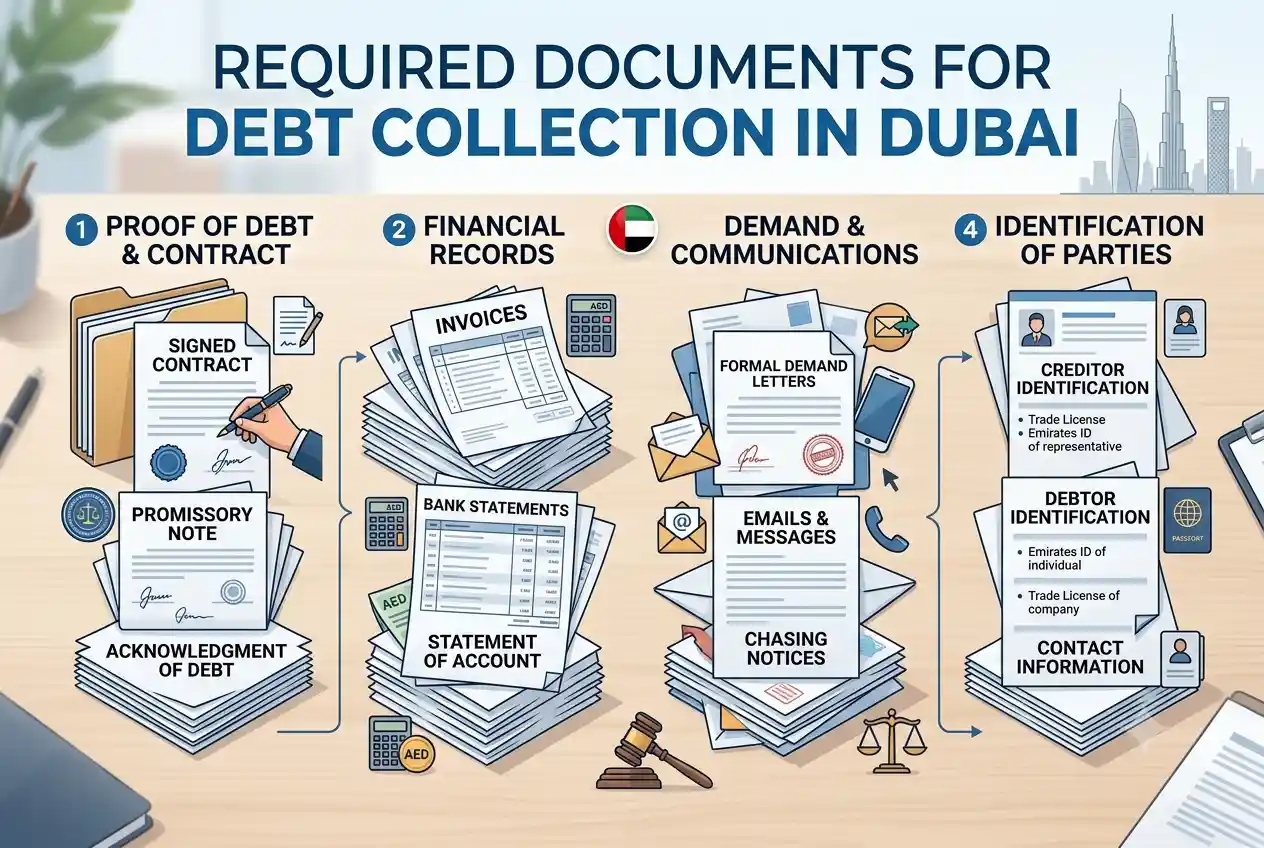
Successful Debt Collection Dubai cases rely heavily on proper documentation. Whether the debt involves an unpaid invoice, a commercial contract, a business loan, or an outstanding service fee, having complete and accurate records significantly improves the chances of recovering the outstanding amount. Documentation serves as evidence that a legal or contractual obligation exists and demonstrates that payment has become due.
In Dubai’s commercial environment, businesses regularly enter into agreements with customers, suppliers, contractors, distributors, and service providers. While most transactions proceed smoothly, payment defaults can occur for various reasons. When a debtor fails to honor their financial obligations, creditors should gather all relevant documents before beginning the recovery process. Proper documentation not only strengthens negotiations but also supports formal legal proceedings if litigation later becomes necessary.
Whether recovery is handled through negotiations, mediation, or court action, organizing the necessary paperwork is one of the most important steps in any Debt Collection Dubai matter.
Why Documentation Is Important
Every debt recovery case depends on evidence. Without supporting documents, it may become difficult to establish the amount owed, the contractual relationship, or the agreed payment terms.
Proper documentation helps:

- Verify the existence of the debt
- Confirm contractual obligations
- Establish payment terms
- Demonstrate non-payment
- Support negotiations
- Strengthen legal claims
- Reduce disputes
- Improve recovery prospects
Well-organized records allow debt recovery professionals to evaluate the case efficiently and recommend the most appropriate recovery strategy.
Primary Documents Required for Debt Collection Dubai
The exact documents required vary depending on the nature of the debt. However, several documents are commonly requested in most Debt Collection Dubai cases.
These include:
- Written contracts
- Signed agreements
- Purchase orders
- Sales invoices
- Delivery notes
- Account statements
- Payment records
- Business correspondence
- Demand letters
- Identification documents
Each document provides important evidence supporting the creditor’s claim.
Commercial Contracts
A written contract is often the strongest piece of evidence in a debt recovery case.
Contracts generally include:
- Names of the parties
- Scope of services
- Goods supplied
- Payment obligations
- Due dates
- Pricing terms
- Default provisions
- Dispute resolution clauses
A properly executed contract clearly establishes the legal relationship between the creditor and debtor.
Purchase Orders
Purchase orders demonstrate that goods or services were requested by the debtor.
Purchase orders usually contain:
- Product descriptions
- Order quantities
- Pricing
- Delivery instructions
- Customer information
- Order dates
- Purchase references
- Authorized signatures
These documents help confirm that the transaction was initiated by the debtor.
Invoices
Invoices are among the most important documents in Debt Collection Dubai matters.
Invoices typically include:
- Invoice numbers
- Billing dates
- Payment deadlines
- Product descriptions
- Service details
- Outstanding amounts
- Tax information
- Supplier details
Invoices provide evidence that payment became due according to agreed commercial terms.
Delivery Notes and Proof of Delivery
When goods are supplied, proof of delivery is essential.
Examples include:
- Signed delivery receipts
- Courier confirmations
- Warehouse acknowledgments
- Customer acceptance forms
- Delivery logs
- Shipping documents
- Freight records
- Electronic delivery confirmations
These documents establish that the creditor fulfilled their contractual obligations.
Account Statements
Account statements provide a complete record of financial transactions between the parties.
Statements often include:
- Previous payments
- Outstanding balances
- Invoice history
- Credit adjustments
- Payment allocations
- Transaction dates
- Interest calculations
- Running balances
Comprehensive account statements help demonstrate how the outstanding amount was calculated.
Payment Records
Payment history is important because it shows previous compliance with contractual obligations.
Useful records include:
- Bank transfer confirmations
- Payment receipts
- Online payment records
- Cheque details
- Deposit confirmations
- Credit notes
- Financial ledgers
- Accounting records
These documents help distinguish paid amounts from unpaid balances.
Email Correspondence
Business communications frequently provide valuable evidence.
Relevant correspondence may include:
- Order confirmations
- Payment promises
- Invoice acknowledgments
- Delivery discussions
- Contract amendments
- Settlement negotiations
- Outstanding balance confirmations
- Collection reminders
Emails often demonstrate that the debtor was aware of the outstanding obligation.
Demand Letters
Demand letters show that the creditor attempted to resolve the matter before pursuing formal recovery.
A demand letter generally includes:
- Outstanding balance
- Invoice references
- Payment deadline
- Contract details
- Request for payment
- Consequences of non-payment
- Contact information
- Settlement invitation
Copies of these letters may become important evidence during later proceedings.
Settlement Agreements
If the parties previously agreed to revised payment arrangements, those documents should also be preserved.
Settlement documentation may include:
- Installment agreements
- Revised payment schedules
- Partial settlement agreements
- Debt acknowledgments
- Extension requests
- Written commitments
- Negotiated repayment plans
- Settlement correspondence
Failure to comply with these agreements may strengthen the creditor’s position.
Identification and Corporate Documents
Businesses should also provide documents confirming the identities of the parties involved.
Examples include:
- Trade licenses
- Company registration certificates
- Authorized signatory documents
- Passport copies
- Emirates ID copies where applicable
- Business addresses
- Corporate registration records
- Contact information
These records help verify the legal identity of both creditor and debtor.
Financial Records
Supporting financial documentation can strengthen a debt recovery case.
Useful financial records include:
- General ledger reports
- Accounts receivable reports
- Customer account summaries
- Internal accounting records
- Outstanding aging reports
- Payment history reports
- Audit records
- Financial reconciliations
Accurate accounting records improve the credibility of the creditor’s claim.
Electronic Evidence
Modern business transactions increasingly rely on digital communication.
Electronic evidence may include:
- Digital contracts
- Electronic invoices
- Online purchase confirmations
- Digital signatures
- Customer portal records
- System-generated reports
- Electronic receipts
- Cloud-based transaction histories
Properly maintained electronic records are valuable supporting evidence.
Organizing Documents Before Recovery Begins
Before initiating a Debt Collection Dubai process, creditors should organize all relevant documentation.
Recommended steps include:
- Arrange documents chronologically
- Separate invoices by customer
- Verify outstanding balances
- Match invoices with payments
- Organize correspondence
- Review contractual obligations
- Confirm payment calculations
- Identify missing records
Well-organized documentation improves efficiency throughout the recovery process.
Common Documentation Mistakes
Some debt recovery cases become more difficult because important records are incomplete or missing.
Common mistakes include:
- Missing signed contracts
- Incorrect invoices
- Incomplete payment records
- Lost delivery confirmations
- Poor record keeping
- Unclear payment terms
- Missing correspondence
- Inaccurate account balances
Avoiding these mistakes significantly strengthens recovery efforts.
How Proper Documentation Supports Negotiations
Most Debt Collection Dubai matters begin with negotiations rather than litigation.
Complete documentation helps by:
- Demonstrating the validity of the claim
- Clarifying payment obligations
- Supporting settlement discussions
- Reducing factual disputes
- Encouraging voluntary payment
- Improving negotiation credibility
- Building confidence
- Facilitating quicker resolutions
Debtors are often more willing to negotiate when presented with comprehensive supporting evidence.
When Additional Documents May Be Required
Certain debt recovery matters involve more complex commercial relationships.
Additional documentation may include:
- Loan agreements
- Guarantee agreements
- Insurance documents
- Lease agreements
- Construction certificates
- Service completion reports
- Inspection reports
- Expert assessments
The specific documentation depends on the nature of the transaction.
Preventing Future Documentation Problems
Businesses can reduce future recovery challenges by maintaining effective documentation practices.
Recommended measures include:
- Using written contracts
- Issuing invoices promptly
- Maintaining digital records
- Recording all communications
- Obtaining signed delivery receipts
- Monitoring customer accounts
- Performing regular reconciliations
- Backing up important files
Strong record-keeping systems improve both operational efficiency and debt recovery outcomes.
Benefits of Professional Assistance
Professional debt recovery specialists can review documentation before initiating recovery efforts.
Their assistance may include:
- Evaluating supporting evidence
- Identifying missing documents
- Reviewing contractual obligations
- Organizing financial records
- Assessing recovery prospects
- Preparing demand documentation
- Supporting negotiations
- Advising on recovery strategies
Professional review often improves the efficiency and success of the recovery process.
Conclusion
Proper documentation is the foundation of every successful Debt Collection Dubai case. Written contracts, invoices, purchase orders, delivery confirmations, payment records, account statements, business correspondence, and settlement agreements all serve as important evidence supporting a creditor’s claim. Organized documentation strengthens negotiations, improves recovery prospects, and provides valuable support if formal legal proceedings become necessary. Businesses that maintain accurate records, monitor outstanding accounts, and preserve all transaction-related documents are better positioned to recover unpaid debts efficiently. By preparing comprehensive documentation before beginning the debt recovery process, creditors can protect their financial interests, reduce unnecessary disputes, and improve the likelihood of achieving a successful outcome in Debt Collection Dubai matters.
Related Reading: Curtains in Dubai: Sheer, Blackout, Wave and Motorized Options Explained
Related Reading: The Ultimate Guide to Shopping Luxury Fashion on a Budget
Related Reading: What Role Does Notarization Play in Family Law Matters for Expatriates in Dubai? — full guide
Related Reading: Top 4 Law Firms for Fraud Cases in the UAE — full guide
Related Reading: What Types of Cases Do the Best Criminal Lawyers in Dubai Handle?