Few places on earth present as striking a visual contrast between heritage and modernity as the UAE. Within a single city block in Dubai or Abu Dhabi, you may find a traditional wind tower standing beside a glass and steel tower, a heritage souk adjacent to a world-class contemporary museum. This is not contradiction. It is the defining character of architecture design in the UAE today, and understanding it is essential to appreciating why the region continues to produce some of the most talked-about buildings in the world.
The architects who are most respected in the UAE are those who have moved beyond the superficial application of Islamic motifs to generic building forms, and who instead engage with the underlying principles of traditional Emirati and Islamic architecture at a deeper level, translating those principles into genuinely contemporary solutions.
The Principles Behind Traditional Emirati Architecture
Traditional architecture in the Gulf was a direct and intelligent response to the specific conditions of the region: extreme heat, high humidity in coastal areas, cultural requirements for privacy and family separation, and the social structures of tribal and mercantile communities.
- The barjeel (wind tower) was a passive cooling device of remarkable ingenuity, catching prevailing breezes at roof level and directing cooled air down into the living spaces below.
- The bayt (courtyard house) organised domestic life around a shaded, private outdoor space that served as the social heart of the home while protecting family life from the public gaze.
- Mashrabiya screens, intricately carved from wood, filtered light, provided privacy, and allowed natural ventilation while maintaining a visual connection to the street.
- The separation of the majlis (formal guest reception) from private family spaces reflected the deep cultural importance of hospitality and the equally deep value placed on family privacy.
These were not simply aesthetic choices. Each element solved a real problem. The most enduring lesson for contemporary architecture design in the UAE is that these problems have not gone away. Extreme heat, cultural privacy requirements, and the need for comfortable outdoor living remain as pressing in 2025 as they were in 1825.
| Key Stat: Traditional Emirati courtyard houses in Al Fahidi Historical Neighbourhood in Dubai maintain interior temperatures up to 10 degrees Celsius cooler than surrounding modern buildings, demonstrating the passive performance of vernacular design. |
How the Best UAE Architecture Firms Reinterpret Tradition
The most accomplished architecture design studios in the UAE today approach traditional architecture not as a historical museum piece to be copied, but as a living repository of principles that can inform genuinely contemporary solutions.
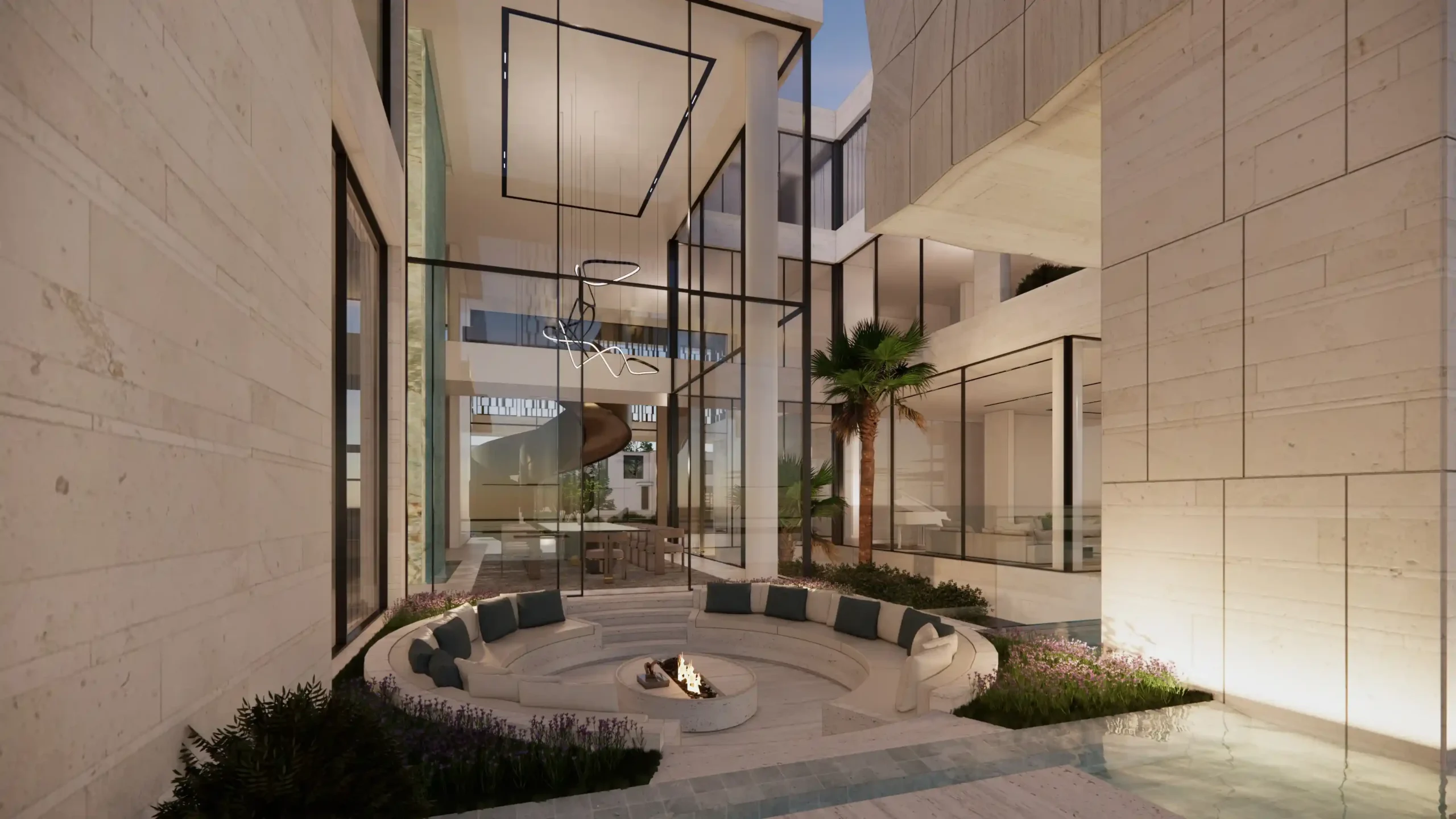
- The Courtyard Reimagined: Contemporary UAE villas and residential developments frequently organise themselves around an internal courtyard or atrium. Where the traditional bayt used unrendered coral stone walls and date palm timber, today’s interpretation may feature a double-height glass ceiling with automated solar shading, climate-controlled planting, and integrated lighting, but the spatial principle and the climate logic remain unchanged.
- Mashrabiya as High-Performance Facade: The traditional carved wooden screen has been translated into sophisticated facade systems using aluminium, GRC, and carbon fibre. These systems perform the same core functions of light modulation, privacy provision, and solar heat reduction, while meeting the technical demands of contemporary UAE construction.
- Geometric Complexity Through Parametric Design: Islamic geometric patterning, one of the most sophisticated traditions in world art, is now being generated through computational design tools. Architects can produce facades, ceiling systems, and screen elements of extraordinary geometric complexity, rooted in the mathematics of traditional Islamic art.
- Privacy Hierarchy in Contemporary Planning: The traditional separation of majlis, family, and service zones is being reinterpreted in contemporary villa design through careful spatial planning that controls visibility and acoustic separation between formal and private areas of the home.
The Risk of Superficial Historicism
Not all attempts to reference tradition in UAE architecture succeed. There is a recognised tendency in the regional market toward what critics call cosmetic heritage, the application of traditional visual motifs as surface decoration on buildings that are otherwise entirely disconnected from traditional principles. A building that applies a mashrabiya pattern as a printed graphic on standard glazing, for example, is invoking the visual language of tradition without any of its functional or cultural intelligence.

The architecture design studios that earn lasting respect in the UAE are those that engage with heritage at the level of principle rather than appearance. They ask what problem the traditional element was solving, and they find a contemporary answer to that same problem using the materials and technologies available today.
International Influence and Local Rooting
The UAE has attracted some of the world’s most celebrated international architects, including Zaha Hadid, Jean Nouvel, Frank Gehry, and Norman Foster. Their presence has enriched the region’s architectural culture, introduced global design rigour, and set a high bar for technical ambition. However, the most enduring contribution to UAE architecture over the coming decades will likely come from locally embedded studios that combine international design standards with genuine cultural knowledge, regulatory expertise, and long-term commitment to the region and its people.
Climate Responsiveness as Cultural Identity
One of the most important points of continuity between traditional and contemporary architecture in the UAE is the primacy of climate as a design driver. Traditional Emirati architecture was almost entirely shaped by the need to manage extreme heat, strong sunlight, and the seasonal khamsin winds. Contemporary architecture design in the UAE must meet this same challenge using today’s tools: high-performance glazing, thermal mass, external shading, mechanical ventilation, and increasingly, photovoltaic integration.
The most culturally intelligent architecture being produced in the UAE today is that which treats climate not as a problem to be solved by engineering alone, but as a design opportunity, a set of forces and conditions that, when engaged creatively, can produce architecture of genuine originality and lasting value.
Frequently Asked Questions
Q: What is traditional Emirati architecture called and where can I see it?
A: Traditional Emirati architecture is most visible at Al Fahidi Historical Neighbourhood in Dubai, also known as Al Bastakiya, which preserves a remarkable collection of traditional coral stone and gypsum buildings with original barjeel wind towers. The Heritage Village in Abu Dhabi and the old souk districts of Sharjah also provide well-preserved examples of pre-modern Gulf architecture.
Q: How do contemporary UAE architects incorporate Islamic geometric patterns?
A: Contemporary architects use parametric design software to generate geometric patterns based on the mathematical principles of traditional Islamic art: rotational symmetry, star polygon systems, and interlocking geometric forms. These patterns are then fabricated using CNC cutting, 3D printing, GRC casting, or laser-cut metalwork to create facades, screens, ceiling systems, and interior feature walls of extraordinary complexity and beauty.
Q: What is the Estidama Pearl Rating System?
A: Estidama is Abu Dhabi’s sustainability framework for the built environment. The Pearl Rating System assesses buildings across categories including energy, water, indoor environment quality, materials, and innovation, awarding a rating of one to five pearls. All new government buildings in Abu Dhabi must achieve a minimum of two pearls, and many private developments now target higher ratings as a mark of quality and commitment to sustainability.
Q: Why do so many UAE buildings look similar despite the variety of architects involved?
A: The prevalence of glass-and-steel towers and similar residential typologies in many UAE developments reflects the pressures of rapid development timescales, cost optimisation, and the influence of a small number of dominant master-planned community developers. The most distinctive UAE architecture, by contrast, tends to emerge from projects with longer design timescales, more engaged clients, and architects who have been given the brief and the budget to genuinely respond to their specific site and programme.
Conclusion
Architecture design in the UAE is at its finest when it treats tradition not as a constraint but as a resource of intelligence that can inform solutions of genuine contemporary relevance. The barjeel and the smart facade are not opposites. They are answers to the same question, separated by centuries of technological development. Explore the portfolio of this UAE architecture design studio and see how tradition and modernity are reconciled in practice. Browse luxury residential projects UAE to see this philosophy applied to real buildings.